Reincarnation Lessons
Why do our souls return?

I went into the woods to die, but instead that's when my life began.
They called it the Autofini, which means self-ending.
Autofini is the lost ancient rite of passage for the terminally ill, or for those whose physical bodies reached their limit.
The name spoke of closure, removing any implication from others concerning their death. No one else bore the weight of decision or guilt.
I had seen pets do something like this: dying animals digging in the dirt in a hidden area, usually inside a bush where no one could see them when they lay down for the last time. Dying with dignity in solitude.
I carved out a shallow coffin in the dirt between two thick juniper bushes, a quiet cradle of earth and roots, and settled in.
Unlike Henry David Thoreau, who went into the woods to discover the meaning of life, I discovered the meaning of death and who I really am, where I really came from, and what truly matters.
After my son’s passing, after the hospital battles and the systems that failed us, I could no longer work or rejoin society as if nothing had happened.
I went into the woods intending the Autofini. But I got back up somehow.
The first night, I went to sleep and heard Milo say in an upbeat voice that sounded like he was seven years old, “Hi Mom!”
His voice jolted me awake. I woke up excited, heart racing with joy, but realized I was still in the woods and it was dark. It had been my imagination—or something more.
His voice was so clear, it felt so good to hear him again. I was pumped with happy feelings of being with him still. Too excited to go back to sleep, I lay awake all night looking up at the stars, remembering his favorite songs as all the memories played out in the sky like a movie.
In the morning I went to the stream to get a drink of water. I justified it as replacing my tears, feeling guilty for breaking the food and water strike meant to accomplish the Autofini.

On day two, I laid again in my dirt coffin bed between the juniper bushes, under the stars. I didn’t care about bugs. Hoping to get bitten by ticks and expedite the mission, I kept my body exposed. Bathing in the moonlight felt similar to sunbathing. Why hadn’t I done this more when I wanted to live?
Milo loved the moon and would howl at it sometimes. I sang a song I had made up for him when he was a baby: “Oh mister moon, moon, bright and shiny moon, shining the stars on me. I wanna catch you, I wanna eat you, I wanna hug you til the sun comes up.”
I created it because he used to reach up to the moon and pretend like he was capturing it and eating it. I was never sure why he did that, he did it before he could talk. He didn’t speak until he was four years old. He understood everything long before he found his voice, and when he finally did talk, it wasn’t just a word here or there, it was full sentences.
The next night, in my dream I heard Milo say, “Hi, mom,” slower, wiser, and more deliberate, the same voice he had at the time of his death when he was nineteen. He didn’t sound happy like the night before.
He sounded like he pitied me and knew more than he could express, conveying through tone and energy rather than language, the same way he had before he was four.
We communicated through emotion and vibration more so than through words. I woke up and called out to him as if he was right next to me. I couldn’t get back to sleep and lay there awake until sunrise.
By afternoon I was thirsty, so I went to the stream again. I sat there staring at the water, feeling sorry for myself all day. Mad at myself for drinking—I was not supposed to eat or drink in order to accomplish the Autofini.
Memories surfaced of the day he was conceived. I had heard a voice say, “Go make a baby.” It didn’t tell me why, but the tone conveyed so much love and filled me with a sense of purpose.
When his father came home from work, I remember telling him that God told me to make a baby, and his eyes lit up as he agreed.
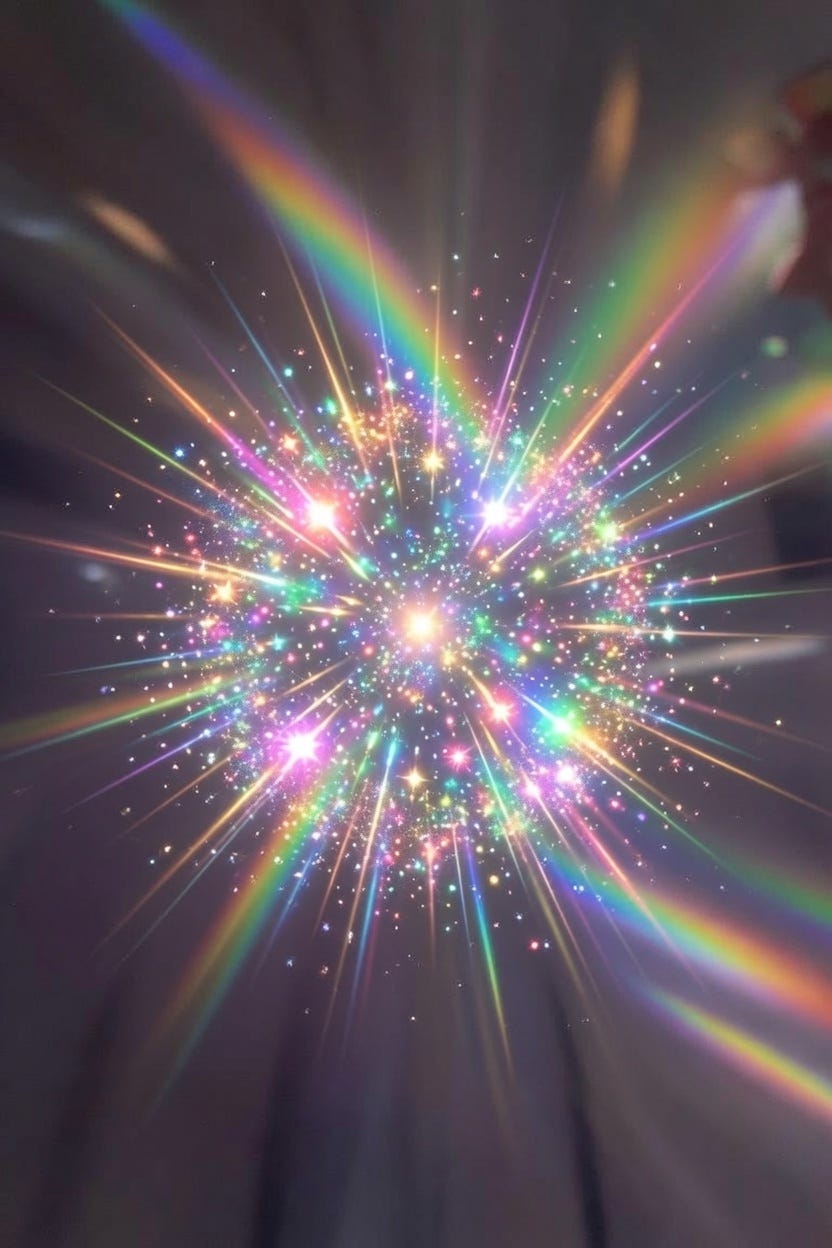
There were no usual sexual feelings, only love. In the room that day there was a light beyond words or actions: an orb without solid lines, shimmering with sparks of pastel colors, a cloud of golden sparks and silver stars, iridescent and alive.
Milo was conceived in that light, or from that light. Maybe that was him. “Why did you come here to suffer? I asked into the silence.
His answer would come the next night I laid in my dirt coffin bed. This time I had a dream about him and stayed asleep.
That night I had a dream about him. We were in a past life together. The first past-life memory had come to me years earlier, when I was about twenty-four, before I knew what real childbirth pain felt like. In the dream, I was in a concrete room with no windows, or if there were any, they were blocked off so I couldn’t tell the time.
It was World War II, part of some Nazi program of experimentation or breeding. I was a strong female soldier, trained to control emotions completely. Feelings and desires were considered selfish; you put the country and the collective first. The stronger you were, the less emotion you showed. They were making super soldiers through endless experiments.
I had been with the Nazis for a long time but had grown to disagree with them, especially what they did in those eugenic experiments, turning innocent kids into something unrecognizable, robotic, insane.
In the dream, I was on a flat, cold table in a clinical setting, covered but freezing, trying to hide that I was about to give birth. A male and female nurse or assistant chatted about their lives while a doctor worked in the back. As they were distracted, contractions tore through me. I pushed secretly, planning my escape. The nurse finally checked and said, “Oh, she’s ready to go,” then fetched the doctor. With one powerful push, the baby came out. “Oh wow, that was quick,” the doctor said. He picked the big, bloody baby up by the ankle. It had black hair. They were looking for babies without black hair. Cruelly, he asked, “Should we kill it or should we experiment on it?” In my emotionless soldier voice, I replied, “Kill it.” As he turned to smile at the nurses, I grabbed the tray table and smashed him over the head. I stabbed one nurse with a long knife, knocked out the other, then grabbed my bloody baby and ran.
The door opened to an empty hallway. Relief flooded me. Outside it was early morning, gray and pre-dawn. A lone German guard was about to light a cigarette.
As he reached for his weapon, I charged past, making myself look big and fierce, bloody baby pressed on me making me look monstrous. I let out a battle cry which made him stop and stare. His hesitation allowed me to pull out his eye with one swioe. I took his keys and kept running toward the gate, past little prisons and holding cells where they conducted mind experiments, creating mental illness in their subjects.
We were back in that WWII time period, but from a different angle. I was a UN aid worker, an administrator sent to tidy up the books in the the orphanages.
The orphanages for German children were a step above the concentration camp. Overflowing with displaced children who had their heads shaved, emaciated, diseased, bodies disposed of in chimney-type furnaces without proper burials. My job was to tweak the books, expedite the mission, reduce suffering by making it happen faster. “This is going to happen whether you’re here or not,” I was told, I did not think for myself. Caring wasn't a job requirement. I worked for nice clothes, a house, a soldier boyfriend.
Milo was one of the orphans as well as a soldier. I watched him die and felt nothing but bureaucratic detachment. How could this be? How could I have been living two separate lives in the same time, in the same country? And he was living as three different people.
When I woke, the weight crushed me. How could one soul live multiple lives like this? Milo helped me see the Shattered Monad, one soul splintered across time and forms, experiencing every side.
I saw the parallels to today: administrative people tweaking medical records to hide harm, making systemic abuse look neat and tidy, erasing stories like Milo’s so the system doesn’t look bad.
Through this, I finally understood real forgiveness. Not the spiritual bypassing of “I forgive you” from above it all, but the hard-won release that comes from seeing the full circle. I had been the bureaucrat. I had been the one who looked away. Now I could forgive because I had lived both sides.
Milo’s answer to *Why did you come here to suffer?* echoed: It wasn’t punishment.
Like Jesus, you suffer so others see and are given a choice—to change, to love, to protect, to treat everyone as connected. Real love isn’t easy agreement; it demands sacrifice, going against culture or career, risking everything. The Shattered Monad fractures so we learn through direct experience. We return until every fragment chooses differently.
Death alone doesn’t free us. We come back. Genuine forgiveness does. It dissolves the attachments and karma binding the Monad, allowing the splinters to reunite and ascend beyond the cycle.
I rose from the dirt coffin and left the woods. There's no reason to go back there except to visit. I imagine that if I see something going on back there, something that requires me to help then I'll return. This is the reason for reincarnation. We keep coming back for many reasons. It's not just to pay off karmic debt or save others. Sometimes we come back just to visit.
By the way, when Milo did first begin talking, he told his sister and I that he had a past life in El Salvador, but the used to call it San Salvador, he said. This was when he was around five years old and I didn't know anything about the politics of it back then (2011). I told you that we he began talking for the first time it was a lot at once. This is one of those conversations. The interesting thing is that he only mentioned this once and he forgot telling us this.
He said his best friend in his past life was named Pancho, but he called him Puncho because they used to play-fight and spar. The boys played rough and everyone did drugs and killed each other. He told me this like it was a normal life for them. I asked if they were at war and he said no, that they all loved each other and were close friends, but that they all did drugs and killed each other.
My daughter found this so weird and funny because it seemed so crazy that she vowed in that moment to name her first dog “Pancho” which she did name her dog years later.
This all came out after I bought them pillow pets and asked them what their names were. Milo came up with the name Pancho. At that age, I don't think he ever met it heard of someone named Pancho.
This makes me wonder how many lives our soul lived simultaneously. How many souls are there? Are we one collective soul? I bet the El Salvador gang members need a lot of help sorting out their karma as well as the people who created the situation that made them.